
Understanding the Tao: Lao Tzu's Path to Effortless Wisdom
Ancient Wisdom
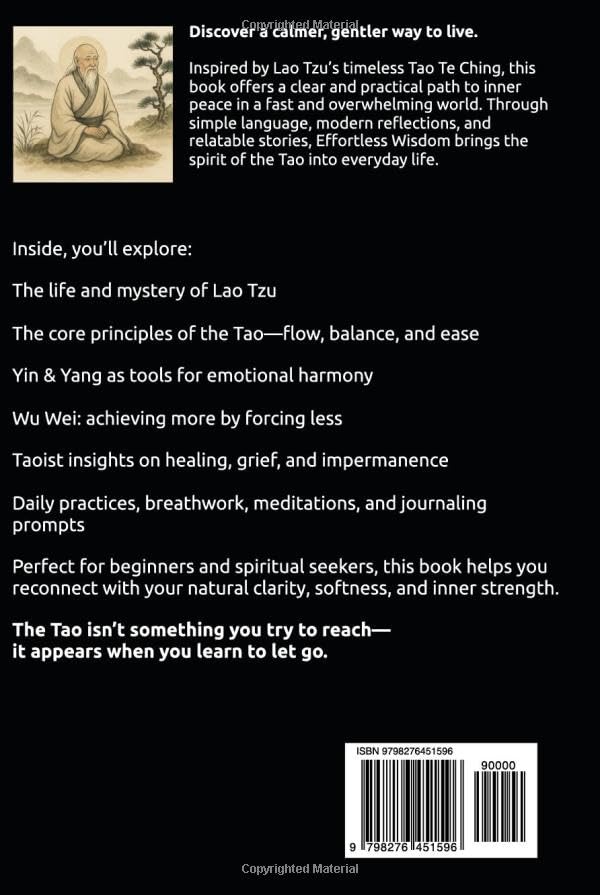
This book turns the Tao from a distant idea into a way of moving through work, grief, relationships, burnout, and daily pressure with more softness and steadiness.
This book turns the Tao from a distant idea into a way of moving through work, grief, relationships, burnout, and daily pressure with more softness and steadiness. Modern life
Author note
"This book helps readers explore: - How Wu Wei changes the way you handle work, stress, and decision-making. - Why softness, humility, and enoughness are forms of real strength. - How to return to steadiness when life feels overdriven."
Sample Reader
Read the opening pages before you commit
Preface Many people move through life as if they are always bracing: against deadlines, against expectation, against uncertainty, against the sheer noise of the age. They push harder, organize more, optimize more, and still feel that something essential kee...
5 sample pages
Approx. 14 min read
Ebook pages 5-12
Opening sample
Enter the reader before you commit to the book
Preface Many people move through life as if they are always bracing: against deadlines, against expectation, against uncertainty, against the sheer noise of the age. They push harder, organize more, optimize more, and still feel that something essential kee...
Reader
Excerpt 1 of 5
Ebook page 5
Preface
Many people move through life as if they are always bracing: against deadlines, against expectation, against uncertainty, against the sheer noise of the age. They push harder, organize more, optimize more, and still feel that something essential keeps slipping further away.
Lao Tzu speaks directly into that condition. His wisdom does not ask you to become impressive, severe, or spiritually theatrical. It asks something both simpler and harder: that you return to a more natural way of living.
This book is for readers who feel overdriven by modern life but do not want to escape life in order to recover themselves. It is for people who want calm without passivity, depth without dogma, and spiritual intelligence that can survive contact with work, family, grief, money, technology, and an ordinary difficult Tuesday.
The Tao is not a doctrine to memorize. It is not a system to perform. It is a way of moving through life with less inner violence, less forcing, and more accord with what is real.
That is the aim of this book: to make Lao Tzu feel usable. Not distant. Not ornamental. Not trapped inside mystical reverence. I want his voice to function here as a guide for modern readers trying to live with more clarity, spaciousness, and steadiness.
You will find history, teachings, parables, practices, and modern applications. But the deeper goal is not information. It is recognition. I want the pages to help you notice where you are making life harder than it needs to be and where a softer, more truthful way is already available.
If the book works, it will not merely tell you what the Tao means. It will help you feel, in your own life, what it is like when effort becomes cleaner, speech becomes simpler, desire becomes quieter, and the mind stops treating every moment like a contest.
That is the spirit in which these pages were written.
The sample is meant to help readers feel the tone, pacing, and depth of the book before committing.
Related philosophy
See how this book feeds the larger frame.
Philosophy
What Aham Vadh Means
Why the project is named after the slaying of the false self, and why sound is the chosen medium for that pressure.
Philosophy
Non-Duality In Sound
How repetition, weight, silence, and rupture can carry non-dual themes more directly than conceptual explanation.
Philosophy
The Egg And Radical Unity
Why Andy Weir's short story lands so cleanly beside Aham Vadh: identity as a temporary mask, and every apparent other as the same life in disguise.